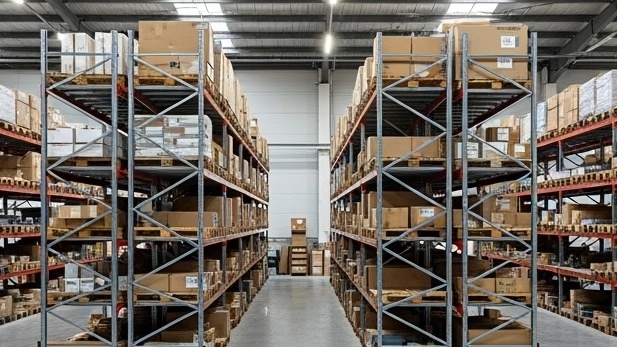
In today's competitive world, optimal space and inventory management is one of the main pillars of the success of any manufacturing, distribution or logistics business. At the heart of this management is a seemingly simple but vital element: industrial shelving. Industrial shelving refers to systems used to maintain and organize goods, raw materials, tools and equipment in industrial environments and warehouses. These shelves are usually made of metal (such as cold rolling steel) or resistant composite materials and are designed to withstand heavy weights and optimize warehouses strategically.
The importance of these systems is beyond a simple organization. A suitable shelving system can dramatically increase productivity, guarantee workplace safety, and reduce operating costs.
Key benefits of industrial shelving you need to know
Your initial text properly mentioned the main benefits. Here are some more detail:
The main types of industrial shelving: Which system is suitable for you?
Choosing the type of shelving depends on many factors such as the type of product, the volume of the inventory, the dimensions of your warehouse and the budget. Here are the most common types of industrial shelving:
1. Rock Pallet (Pallet Racking System)
This system is the most common and most used shelving type in large warehouses. As the name implies, it is designed to hold heavy and bulky goods on the palette.
- Application: Distribution warehouses, logistics centers, refrigerators and manufacturing factories.
- Benefits: Direct and Easy Access to any Pallet, Compatibility with Types of Forklifts, High Strengths.
- Sub -Types:
- Rock Selection: Provides pallets.
- Drive-in Rack: To store high-density LIFO system. The forklift enters the shelf to put or remove the palette.
- Rock Rack Clothing: Another LIFO system where pallets are placed on sloping rails and push inward.
2. Cantlever Racking Shelf
This type of shelf lacks vertical columns in the front and is designed to store long, bulky and irregular goods. Arms come out of a central column and the goods are placed on these arms.
- Usage: Pipe maintenance, metal profiles, wood timber, carpets, furniture and sheets.
- Benefits: Ideal for long and deformed goods, adjustable arms adjustment, easy loading and discharge.
1. Bolt shelving (bolt and nut shelving)
This system, also known as lattice or lightweight shelf, is one of the simplest and most economical types of shelving. It consists of metal plates and corners that are connected to bolts.
- Application: Archives of offices, spare parts warehouses, stores and small workshops. To keep lightweight goods and small boxes.
- Benefits: Very reasonable price, easy installation, high flexibility to change the number and distance of the floors.
1. MEZZANine Flooring shelving
Mice shelving is actually a structural solution to double or triple the warehouse space. This system increases the warehouse level by creating one or more new floors in the space. These floors can be used for office, lightweight production space or combination with other types of shelving.
- Usage: High -ceiling warehouses that lack horizontal space.
- Benefits: Extraordinary optimization of vertical space, creating multipurpose space, less cost than building a new building.
1. Self-shelving or driver (Drive-in/Drive-Thru Racking)
This system is designed to achieve maximum storage density. In this model, the corridors between the shelves are removed and the forklifts enter the tunnels created in the shelf structure for loading or discharge.
- Usage: High -volume storage warehouses (such as refrigerators and food warehouses) that do not require quick access to individual pallets.
- Benefits: High Storage density, Optimal Use of Space.
- Disadvantages: Limited access to Pallets (FIFO). Tro).
How to choose the best shelf system for our warehouse?
Choosing the wrong in this area can lead to capital loss, reduced productivity and even safety risks. Before making decisions, carefully examine these factors:
Key points in installation, maintenance and safety
Buying a quality shelving system is only half the way. Correct use and maintenance of it is necessary to ensure the safety and life of the system.
- Professional Installation: Always entrust the shelves to the experienced and experienced teams. Incorrect installation can lead to the collapse of the structure and the occurrence of catastrophes.
- Periodic inspections: Regularly (eg monthly or seasonal), check the entire system to find any damage such as columns recess, bending arms, loosening of screws or rusting. Any injury should be reported and repaired immediately.
- Employee Training: Forklift operators and warehousing staff must be taught on the correct loading, weight restrictions of each floor, and how the injury reports.
- Clear Labeling: Each row and floor should be tagged. This prevents dangerous overdose.
The future of industrial shelving: Automation and Artificial Intelligence
The warehousing world is moving quickly to automation. Shelving systems are no exception.
- Auto Reserve and Recovery Systems (AS/RS): These systems use automatic robots and shuttles to move goods on very long and dense shelves. This technology maximizes accuracy and speed.
- Merchanting with warehouse management software (WMS): Smart shelves can be equipped with RFID sensors and tags to automatically communicate with WMS and provide accurate information on the inventory and location of each product.
Conclusion: Shelving, a strategic investment
industrial shelving is no longer the only set of metals to store goods; Rather, it is a strategic asset and spine of a modern and efficient warehouse. A proper system can transform your space, peak productivity, guarantee safety, and ultimately help your business grow.